
Glimmer: Interactive Fanfics
Glimmer Fics Inc.Entertainment
4.6534.00 Reviews
- Version
- 1.0.41
- Installs
- 10.00K
- Age Rating
- Teen
Screenshots
Our Review of Glimmer: Interactive Fanfics
 Analysis by Appyee
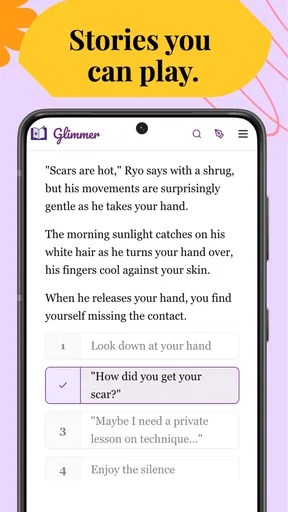
I approached Glimmer: Interactive Fanfics as something between a reading app and a light entertainment game. That distinction matters, because it is not aimed at people who simply want to open a novel and read from the first page to the last. The appeal is choosing how a story develops, then living with the direction those choices create. In my experience, that makes it best suited to readers who enjoy fanfiction-style storytelling but want a more active role than they get from a conventional fiction app.
The app is free to download and belongs to the entertainment category. It comes from Glimmer Fics Inc., carries a Teen content rating, and is available for devices running Android 7.0 or later. Its store summary, “Choose your own adventure,” is brief, but it points toward the central experience: you are not only consuming a story; you are deciding how to move through it. That sounds simple, yet the difference becomes noticeable after a few choices, especially when you start treating each decision as part of your own version of the narrative.
My recommendation depends less on whether you like reading and more on what you expect from interactive fiction. If you want long-form literary control, a huge social writing community, or a traditional game with elaborate systems, this may feel limited. If you want an easy way to spend a short break making story decisions, Glimmer has a clearer purpose and less setup than many alternatives.
How I would decide whether Glimmer fits
I would judge Glimmer by whether I still want to return after the first few stories, not by how entertaining one choice feels on its own. A good test is to notice whether the decisions make reading more personal or merely interrupt the flow; that difference will shape whether it becomes a useful short-break habit. The next section looks at how that appeal may hold up from one month to the next.
Start with the kind of attention you want to give it
The first question is whether you prefer passive or active entertainment. A standard fiction reader lets you settle into someone else’s pacing. A video platform gives you almost no influence over what happens next. Interactive fanfiction sits between those experiences. You still follow a written narrative, but the app asks you to participate at key moments.
That makes Glimmer a good match for short sessions when I want something more engaging than scrolling but less demanding than a full game. I can read, pause, and return to the story without needing to remember a complicated control scheme. The important mental shift is to stop expecting every choice to be a puzzle with a visibly correct answer. The value is in seeing how the story responds to the direction I select, not in “winning” every scene.
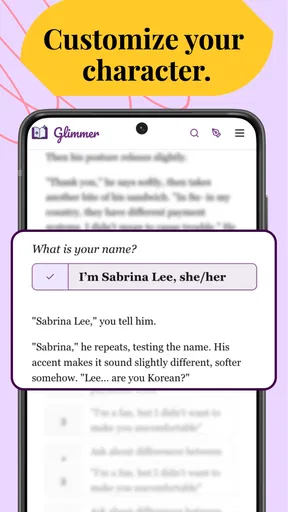
I also found that the app works best when I make choices based on the character or mood I am trying to create. Selecting an option simply because it appears safest can make the experience feel mechanical. Choosing according to a preferred personality or relationship style gives the story more personal meaning, even when the underlying format remains straightforward.
Think about your tolerance for branching stories
Interactive fiction can be appealing precisely because it suggests multiple possibilities, but branching storytelling also has a trade-off. Every new path requires writing, editing, and continuity work. A story with many decisions may offer variety while keeping some branches relatively compact. A story with fewer decisions may feel more polished but give you less control.
That is the main decision criterion I would use here: do you want the feeling of influencing a fanfic, or do you want a deeply simulated world where every action has a complex consequence? Glimmer is more naturally suited to the first expectation. It is entertainment built around narrative participation, not a replacement for a large role-playing game or a serious writing platform.
For a first session, I would avoid rushing through every option. Read the surrounding text carefully, notice the emotional context, and choose the response that fits the version of the protagonist you want to play. This small change in approach makes the app feel less like tapping through prompts and more like co-authoring a personal route through a story.
Consider the audience rating before sharing a device
The Teen rating is relevant for families and younger users. It does not mean every story will suit every teenager, and it is a reminder to consider the themes before handing the app to a child. I would be comfortable recommending it as a Teen-oriented entertainment option only when the reader and parent are already comfortable with fanfiction themes and interactive relationship storytelling.
That rating also helps define the intended audience. This is not positioned as a children’s picture-book app, nor does it appear designed around educational reading. Someone looking for simple stories for young children should choose a more age-specific service. Glimmer makes more sense for teens and adults who already understand the tone and conventions of fanfiction.
Where the app feels most convincing
The strongest part of the experience is the low barrier between opening a story and making a meaningful decision. There is no need to learn a complicated game system before the narrative can become interesting. For me, that directness is more valuable than a large collection of decorative features. The app’s purpose is easy to understand once a story begins.
It is also a useful format for readers who enjoy imagining alternate outcomes. In an ordinary fanfic, I may wonder what would happen if the protagonist answered differently, trusted another character, or took a risk. An interactive format turns that thought into an action. Even when the result is not dramatically different, the act of choosing creates a stronger sense of involvement than simply reading a fixed chapter.
Another advantage is its suitability for irregular reading. I can use it during a commute, before bed, or while waiting for an appointment without committing to a long uninterrupted session. A conventional novel may be better when I want sustained immersion, but Glimmer is easier to pick up when I have only a small amount of time and still want a complete entertainment activity rather than a few random social posts.
The app also benefits from being specific about its emotional appeal. It is not trying to be every kind of entertainment at once. Its identity comes from interactive fanfiction, so readers who already enjoy character-focused stories can understand the attraction immediately. That focus is a strength when the format matches your taste.
Three practical ways I would use it
My first use case is a short evening reset. Instead of opening a streaming service and spending several minutes deciding what to watch, I can enter a story and make a few choices. This works when I want a small narrative escape but do not have the energy for a film, a book, or a more involved game. The key is to treat it as a compact experience rather than expecting a full night of content from every session.
My second use case is replaying a familiar type of story with a different attitude. On one run, I might choose the cautious response; on another, I might select the bold or confrontational option. This is where interactive fanfiction has an advantage over ordinary reading. I can compare the emotional shape of my decisions without needing to invent the entire alternate scene myself.
My third use case is sharing the decision-making with a friend. One person can read the passage aloud while the other argues for an option, or both can discuss what a favorite character would do. This does not turn the app into a multiplayer game, but it gives a simple narrative a social layer. The best conversations come from disagreeing about motivation rather than searching for a supposedly perfect answer.
A less obvious tip is to keep track of why you made a choice, at least mentally. If a later scene feels unexpected, remembering your original intention helps you judge the result as a story consequence rather than a random interruption. Another useful habit is to pause after an important decision instead of tapping immediately through the next text. Interactive fiction is more satisfying when I let the choice register as part of the reading experience.
What may frustrate you
The same simplicity that makes Glimmer approachable can also make it feel narrow to experienced gamers. If you are looking for inventory management, tactical combat, exploration, character statistics, or a large world to investigate, this is the wrong category of product. Its interactivity is narrative-first. The choices matter because they shape the reading path, not because they unlock a broad mechanical system.
Readers who dislike fanfiction conventions may also struggle to connect with it. The format often depends on familiar character dynamics, heightened emotions, and scenarios that prioritize personal involvement over realism. That is not a flaw for the intended audience, but it means the app will not replace a carefully edited literary fiction service for everyone.
There is also a financial consideration. The app is free, but it includes in-app purchases ranging from $0.99 to $99.99 per item. That wide range means I would pay attention to the purchase screen and avoid treating every continuation or optional item as automatically necessary. The free entry point is useful for testing the format, while the purchase structure may be less comfortable for readers who want a completely predictable entertainment budget.
My practical advice is to decide in advance how much you are willing to spend, if anything, and keep that limit separate from the excitement of a cliffhanger. Interactive stories are particularly good at making the next choice feel urgent. A pause before buying is worthwhile, especially for younger users or anyone sharing a payment method with family.
How Glimmer compares with the usual alternatives
The comparison is less about which format is best and more about what I want from a reading session: a fixed story, open-ended browsing, or choices that steer the experience. I would also weigh the effort each option asks of me, since convenience can matter more than breadth when I have only a few minutes. That makes it easier to see where Glimmer fits—and where another kind of app may serve me better.
Compared with ordinary fiction readers
A standard fiction app is the better choice when I want uninterrupted prose, a stable pace, and the author’s intended structure. It also suits readers who dislike being pulled out of a scene to make decisions. Glimmer wins when the act of choosing is part of the entertainment. The trade-off is that the story may feel less like a finished book and more like a guided set of possibilities.
If I am tired and want to relax without making decisions, I would choose a normal reader. If I am curious about alternate reactions and want my preferences reflected in the route, I would choose Glimmer. Neither format is universally superior; they serve different moods.
Compared with large fanfiction communities
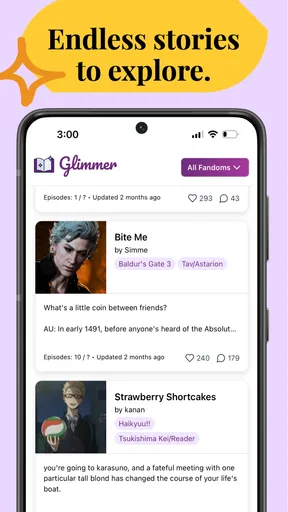
A community-based fanfiction platform usually offers the feeling of browsing a broad library, following writers, and discovering many individual interpretations. That can be better for readers who want maximum choice or who enjoy participating in a writing culture. Glimmer is more focused on the interactive side, so its value comes from guided decision-making rather than simply searching through a large collection.
The switching cost between these options is low in one sense: both are reading-centered, and the basic habits transfer immediately. The bigger difference is expectation. Someone moving from a community library may miss open-ended browsing, while someone moving from Glimmer to a fixed story may miss the ability to influence events. I would choose based on whether discovery or participation matters more to me.
Compared with narrative games
Narrative games can offer stronger audiovisual presentation, exploration, and systems that make decisions feel physically embedded in a world. They also ask more from the device, the player’s time, and sometimes the player’s patience. Glimmer is more convenient when I want the story decision itself without learning controls or committing to a large game.
That convenience comes with a clear limit: readers seeking deep consequences may eventually want a more elaborate game. Glimmer is best viewed as an accessible interactive reading experience, not as a substitute for every choice-driven title on mobile.
What switching really costs
Moving away from Glimmer after trying it does not require a major change in routine. The main adjustment is accepting that another app may prioritize a different part of the experience. A novel reader removes decisions, a community platform expands browsing, and a narrative game adds mechanics. The cost is mostly losing the particular balance of quick reading and personal choice.
If purchases are involved, I would be more deliberate before switching between stories or services. Free access makes experimentation easier, but optional spending can accumulate if I treat every route as essential. I would first decide whether the current story format is genuinely holding my attention, then spend only when the added content feels worthwhile rather than because I have already invested time.
Device compatibility is straightforward for many older Android phones because the minimum requirement is Android 7.0. The current version is 1.0.41, which is useful context for anyone checking whether an older device can run it. I would still install it on the device where I expect to read most often, because convenience matters more here than raw technical performance: if opening the app feels like a chore, the short-session advantage disappears.
Who should try it first
I would recommend Glimmer to a Teen or adult reader who already enjoys fanfiction, likes making character decisions, and wants entertainment that fits into small pockets of free time. It is especially appealing if you often imagine alternate responses while reading and wish you could test those possibilities without writing an entire version yourself.
I would be more cautious about recommending it to someone who wants a completely free experience, dislikes in-app purchase prompts, or prefers stories with no interruptions to the author’s structure. I would also point gamers toward a fuller narrative game if they expect exploration, progression systems, or complex consequences.
My final recommendation
Glimmer: Interactive Fanfics earns its place as a focused entertainment app because it understands the appeal of participating in a story. It does not need to become a full game to be enjoyable. Its best moments come from small decisions that make a familiar fanfiction setup feel personally directed, particularly when I play according to a character idea instead of tapping randomly.
The app has also found a respectable audience, with an average rating of 4.6 from around 4.5 thousand ratings and more than 10 thousand installs. Those figures suggest that the concept is connecting with readers, although they should not replace your own test of the format. Since the app is free to start, the sensible approach is to try it without assuming that every story or purchase will suit you.
My clear recommendation is to give it a chance if you want a lightweight, choice-driven reading experience and already like fanfiction’s character-focused style. Start slowly, make decisions for a reason, and set a spending boundary before exploring paid items. Choose a conventional reader when you want uninterrupted prose, a community platform when discovery matters most, or a larger narrative game when you want mechanics and deeper simulation. For the right reader, Glimmer is not a replacement for those alternatives; it is the convenient middle ground between reading a story and helping steer it.
Verdict
Strengths of Glimmer: Interactive Fanfics
- Interactive stories offer more involvement than traditional fanfiction.
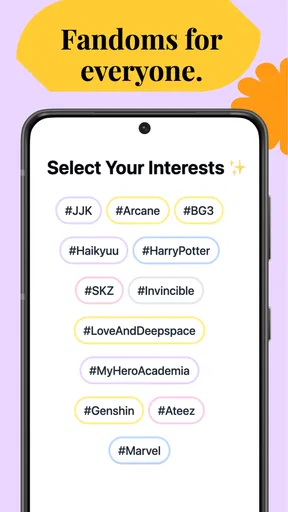
- A wide range of fandom-inspired plots keeps the experience varied.
- Choice-based reading makes each session feel personal.
- Short chapters are convenient for quick reading breaks.
- The app encourages creative engagement with familiar characters.
Limitations of Glimmer: Interactive Fanfics
- Some story paths may feel limited despite offering multiple choices.
- Quality can vary noticeably between different fan-created stories.
- Romance-focused content may not suit every reader.
- Frequent updates or new chapters may depend on individual creators.
- The app may become repetitive if you follow only one fandom.
Similar Picks in This Category
View All
Google Play Games
Google LLC3.9

Netflix
Netflix, Inc.4.8

YouTube Kids
Google LLC4.2

Disney+
Disney4.4

Prime Video
Amazon Mobile LLC4.7

Steam
Valve Corporation3.2
Frequently Asked Questions
What is Glimmer: Interactive Fanfics?
Glimmer: Interactive Fanfics is a story-driven reading app built around interactive fanfiction. Instead of only reading a fixed narrative, you follow episodes, explore dramatic scenes, and sometimes make choices that influence the direction of the story. It is aimed at readers who enjoy romance, fandom-inspired plots, character drama, and a more participatory alternative to traditional fanfiction platforms.
Is Glimmer: Interactive Fanfics free to download and use?
The app can generally be downloaded for free, but some stories, episodes, choices, or premium features may require in-app purchases, credits, or a subscription. The exact pricing and availability can vary by platform, region, and current promotion. Before starting a story, check whether it is marked as free or premium and review the purchase information so you understand what can be accessed without spending money.
How do choices affect stories in Glimmer?
Interactive stories may present decisions that change dialogue, relationships, scenes, or the way an episode unfolds. However, not every choice necessarily creates a completely different ending; some decisions mainly alter the reading experience or unlock additional moments. If you want to explore every possible outcome, you may need to replay chapters, use premium choices, or make separate decisions during different playthroughs.
Does Glimmer: Interactive Fanfics require an internet connection?
An internet connection is normally needed to download stories, load new episodes, synchronize progress, display media, and process purchases. Offline reading may be limited and can depend on whether specific content has already been cached by the app. For the smoothest experience, use a stable Wi-Fi or mobile-data connection, especially when opening new chapters or updating the story library.
Is Glimmer: Interactive Fanfics suitable for all ages?
The appropriate age rating depends on the individual stories and the version of the app available in your country. Interactive fanfiction can include romance, emotional conflict, mature themes, suggestive situations, or language that may not be suitable for younger readers. Parents should check the store rating and in-app descriptions before allowing access, while users should review content warnings whenever they are provided.
